The simplicity of a collage
If only finding ourselves were just as easy
The hunter-gatherer mindset
If I went digging into the dumpster behind that one grimy Burger King with 2.4 stars to bring you back a nice Whopper and fries, you would think that I am insane. I would hope you wouldn’t eat it, unless you really had to.
We no longer hunt or gather food for survival; we shop at conveniently far supermarkets with frozen food sections and parking lots larger than some Mesopotamian cities.
We drive our compact cars there with Apple CarPlay, seat warmers, and cupholders that were not designed for the atrocity that are Stanley tumblers (yet we still try to smash them in there).
Surrounded by convenience and lacking any form of friction, seemingly unbothered by our Darwinistic need for survival, there is now an abundance of time to search for a higher purpose. We function in a society perhaps too complex and advanced for our primitive needs, but these never completely disappear.
I have to wonder, are we really “built” to function this way?
In the research article, Natural selection and the elusiveness of happiness (2004), R. M. Nesse shares a similar (and more eloquent) hypothesis:
Just a few thousand years ago, most individuals allocated their effort among a limited variety of tasks: gathering food, taking care of kin, participating in the group, etc. But as social groups enlarged and roles became more specialized, the requirements for success have escalated so that the big rewards now go to those who allocate a huge proportion of their life’s effort to one domain, and sometimes even just to one goal…
Our brain regulation systems were never designed to cope with efforts so long in duration, towards goals so large, with all-or-none outcomes that offer few alternatives. It is relatively easy to give up on looking for nuts when several days of foraging have proved fruitless. Giving up on a PhD programme after 5 years, or a marriage after 10 years, are decisions orders of magnitude larger, decisions whose costs often lead individuals to persist in the pursuit of hopeless or unwanted goals, creating the exact situations that disengage motivation and cause depression.
The other day, I watched as a beaver chewed on a tree tirelessly, taking pieces off for its dam. Its ultimate purpose. It brings back the scraps to survive and to help its offspring do the same. It guarantees the safety of today in the uncertainty of water, and does not concern itself with much else.
I enjoy observing the pigeons in big cities: scanning the ground, fighting for scraps, and avoiding the ambling pedestrians who stare down in the same manner (but we look for a different type of nourishment, and the ground no longer offers it). The pigeons survive today and fly back to their nests to try again tomorrow. That is their ultimate purpose.
Contrary to both logical reasoning and our instincts, the complete fulfillment of our basic needs does not guarantee happiness; it only allows for a newer, more twisted kind of suffering to lurk in the depths of our subconscious. We have gained misery from imaginary problems, and when those run out, the mind forces the development of more against our cognitive will. We have become “inhabitants of diseased bodies,” as Jefferson calls it, despite being more capable of living than ever.
There are indeed (who might say Nay) gloomy & hypochondriac minds, inhabitants of diseased bodies, disgusted with the present, & despairing of the future; always counting that the worst will happen, because it may happen. To these I say How much pain have cost us the evils which have never happened!
— Thomas Jefferson, Letter to John Adams
By fulfilling all of our desires, continually commodifying our basic needs, we have abandoned our fundamental necessity for tangible, rudimentary successes. Challenges have become more abstract; concepts like mortgages and salaries now dictate survival, rather than the amount of berries collected. As our lives extend, so does the scope of our ultimate purpose. Yet that intrinsic, primitive itch to hunt and collect remains ever so prevalent, with less gratifying avenues to scratch it.
The hunter-gatherer mindset is an active part of our psyche, evident by its corporate leveraging for profit and control. We scroll short-form content, searching for videos to share with our friends, much like our ancestors foraged and provided for their clan. These reward systems are intentionally, arguably malevolently, designed to take advantage of this trait. Scrolling, however, is a mindless, momentary solution to a deeper psychological and existential need. In the lapses of succumbing to it, the void of what I would call a “comfortable” existence looms over us.
The existential void must be channeled
There is no denying the complexity of the modern age, the loneliness and frustration of abstracting our goals. Ironically, we face an incessant internal turmoil in the age of totalitarian autonomy (or the illusion thereof) and instantaneous, addictive gratification. There is a strange chaos within us, as Nietzsche calls it, one that we are often forced to keep contained.
I say unto you: one must still have chaos in oneself to be able to give birth to a dancing star. I say unto you: you still have chaos in yourselves.
– Friedrich Nietzsche, Thus Spoke Zarathustra
Inner chaos means an impending, drastic evolution, a supernova-like reaction towards metamorphosis. I fear that we are no longer conditioned to reveal this chaos; we live in an era when it is easiest and most acceptable to keep it contained. Distractions make it easy to ignore.
Both our instinctual needs and our spiritual desires are suppressed by the current societal conditions.
I have to wonder if inner peace is truly achievable these days, or if ever. If it was, it must look very different from now. Consciousness is a self-eating snake, by being hyper-aware of our purpose (or lack of one) we may overcomplicate our very existence, suffering more from imagination as Seneca says.
I think back to the cave wall drawings, and I have to wonder if they felt a similar void. If they felt our inner chaos, even when survival remained the primary priority and consciousness had less time to creep into cognition.
The channeling of the inner chaos, a statement evident of our existence, has been around since the beginning of time. But what I found most interesting about paleolithic rock art is the canvas and the environment. It is representation, but it is hidden in dark caves and forced upon cold rocks. These qualities may have helped us discover it, shielding it from the elements and preserving it, but does that mean they also created art elsewhere, more public, that did not last long enough?
Nonetheless, they created. We created. We etched and drew where none may see before we had proper linguistic capabilities. The inner chaos may have been quieter, but perhaps it has always been inevitable. Art may not resolve our turmoil, or change our circumstances, but it is evidence. Across time and space, we are here, and we are alive, and we are changing.
The collage as union
There has been a revival in the appeal of the collection and repurposing of objects and ideas. Recycling as a form of expression rather than merely an altruistic process, likely also a rebellion to consumerist culture. I immediately think to the cultural phenomenon of thrifting, of the “vintage” trend. This Dadaistic statement through repurposed fashion reveals both our aforementioned qualities (or chaoses): the hunter-gatherer instinct and existential void.
You are forced to search for items amidst a heap of options, pieces that have a sense of quality to them, to ultimately express yourself and share with others. You collect ideas and stories through fabric and clothing, sorted into a wardrobe for mixing and matching, and then wear them as a statement.
The same trend can be observed in digital and visual media with the rehashing and repurposing of media, such as edits or mixed media. There is an understood cultural value for the discovery and readaptation of content, especially the forgotten, even if it is not ours intrinsically. “If no one else will use it, if it will no longer serve a purpose, I may as well find one.”
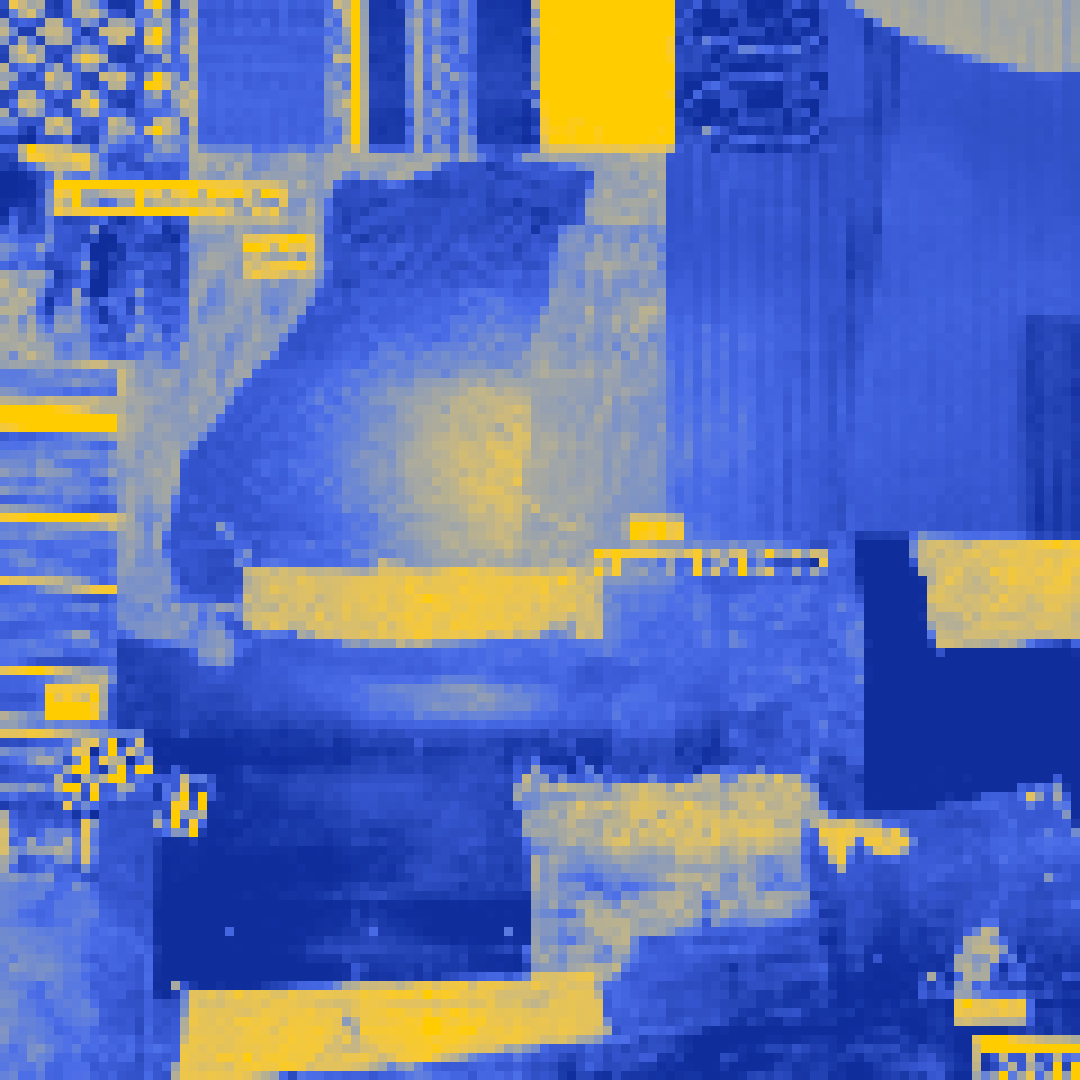
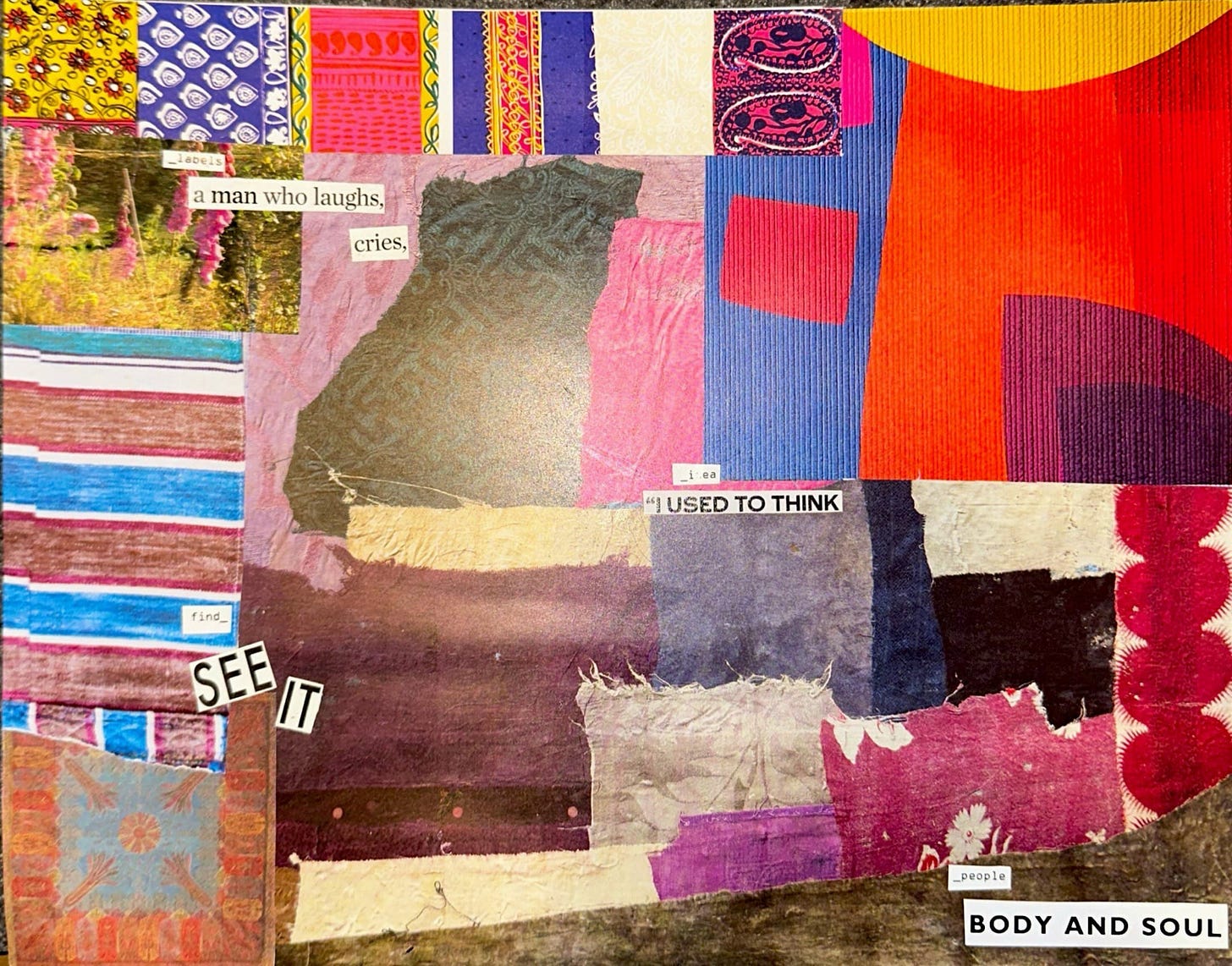
The most apparent example, and maybe the most overdone, is the collage. Discarded magazines and newspapers, images and words, glued together to be readapted and given new life, gaining new meaning. Art de Vivre Magazine refers to them as, “a world of fragments,” in one of the article headers for their article on Picasso. Fragments of ideas and feelings from a fragmented world can be glued together to give voice to a different fragment.
There is a comical simplicity to the collage. It is so simple, even a toddler can do it (as long as they don’t eat the glue). Anyone can do it, but you cannot let that fool you, for that is the collage’s greatest asset.
The absurdity of its simplicity is revealing: we are beings who feel incomplete, using incomplete pieces for the illusion of a more complete product. But it is that same simplicity that we so primitively crave, from the act itself to the effort required for completion. Collages can take as long as five minutes, and are typically already made from scraps. Abandoning one would cause little stress. As a result, they feel extremely rewarding. However, they can reflect much more complexity.
Collages are statements, they are expression. Interestingly enough, they are often self-reflective (e.g. vision boards and photographic memories). Vision boards are particularly intriguing, they are a physical embodiment of the strange abstractive nature of our long-term goals. Rather than writing down where we want to be in a couple of years, we use images and words, fragments not of our own, to express a feeling. Goals are chased to achieve a feeling, an intangible form, not a physical state.
Collages glue the visible and invisible, the intangible and tangible, the actualized and imaginary, they are the interplay between our brain’s need for simple task completion and our mind’s need to resolve our inner chaos. Picasso did not invent the collage; it is a byproduct of our compulsion to collect, not to survive, but to try to live.
So, when you feel hungry, grab a couple of magazines. And when you feel dread for your future, cut up and glue your favorite images and words together. Let the collage of your instinct and disordered mind free, and listen to all it has tried to tell you since you were born into this world.